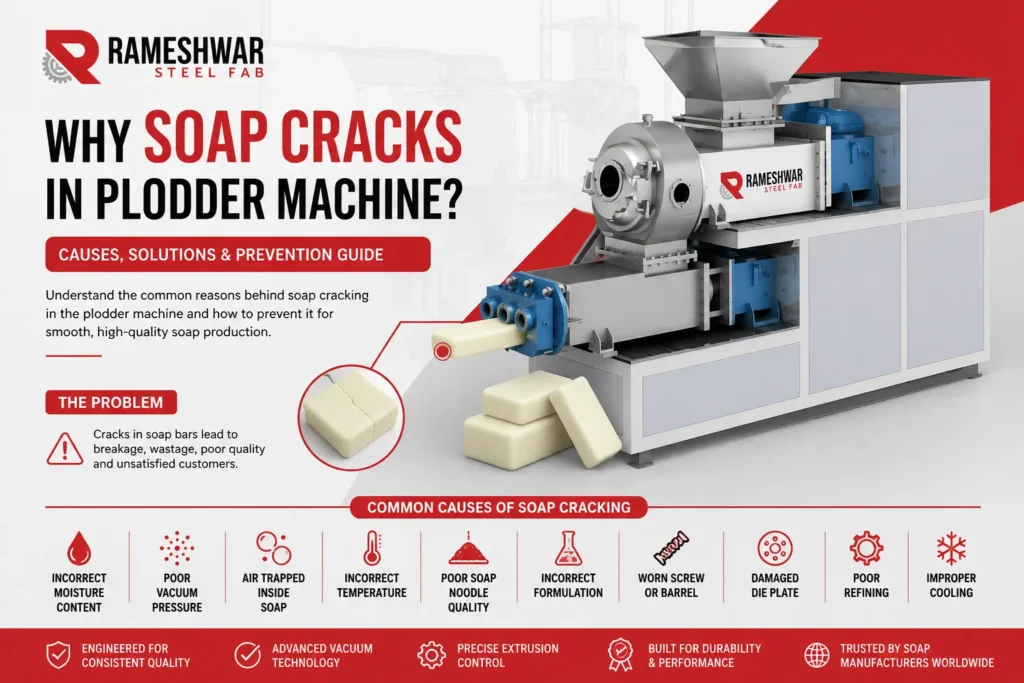
Why Soap Cracks in a Plodder Machine? Causes, Solutions & Prevention Guide
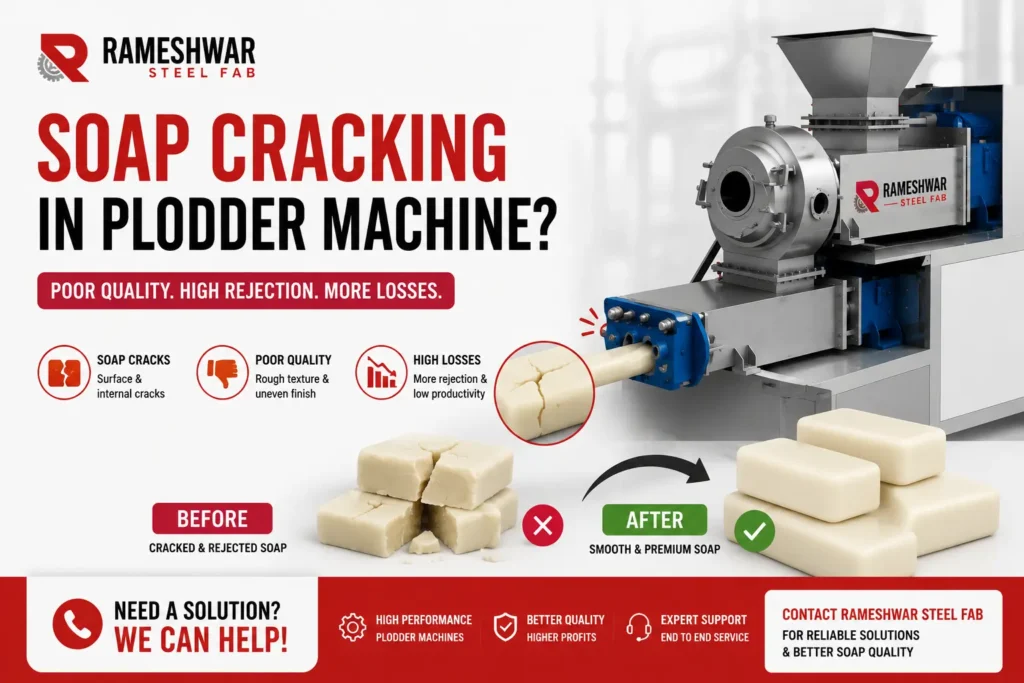
If you run a soap plant long enough, you will meet this problem sooner or later: perfectly good soap noodles going into the plodder, and cracked, broken bars coming out the other end.
Soap Cracking in Plodder Machine is one of the most common — and most misunderstood — issues in soap production. It is rarely about one single mistake. It is usually a combination of moisture, vacuum, temperature, and machine condition working against each other at the same time.
We have spent over two decades building and troubleshooting soap making plants and Duplex Vacuum Plodder Machines for manufacturers across India, Africa, and the Middle East. In this guide, we will walk through exactly why cracking happens, how to fix it on the floor, and how the right plodder machine prevents it from happening in the first place.
Quick Answer: Soap cracks in a plodder mainly due to incorrect moisture content, trapped air from poor vacuum, wrong barrel temperature, worn screw or die components, or poor-quality soap noodles. Fixing cracking means correcting these factors together, not one at a time.
What Is Soap Cracking?
Soap cracking is a surface or structural defect where the extruded soap bar develops visible lines, splits, or flakes right after it leaves the plodder or shortly after cutting and stamping.
It shows up in different forms:
- Fine hairline cracks on the surface
- Deep splits running through the bar
- Edge chipping during cutting or stamping
- Cracks that appear only after a few hours of cooling
Each pattern usually points to a different root cause, which is why this is a genuine Soap Bar Quality Issue, not just a cosmetic one.
Why Does Soap Crack During Plodding?
During plodding, soap noodles are compressed, de-aired under vacuum, and extruded through a die under pressure. This is where soap gets its final density and smooth texture.
If the noodle composition, machine settings, or mechanical condition are off even slightly, the soap mass does not bind together evenly. The result is internal stress inside the bar, and that stress releases as a crack.
This is one of the most frequent Soap Manufacturing Problems we get asked about, and it almost always traces back to one or more of the causes below.
Common Causes of Soap Bar Cracking
Incorrect Moisture Content
Too little moisture makes the soap mass brittle and dry. Too much moisture creates a soft, unstable bar that cracks on cooling.
Fix: Maintain moisture within the formulation’s ideal range, typically checked with a moisture analyzer before feeding noodles into the plodder.
Poor Vacuum Pressure
Weak vacuum leaves air pockets inside the soap. When the bar is cut or handled, these pockets become crack points.
Fix: Check vacuum gauges regularly and ensure vacuum pump seals and gaskets are airtight.
Air Trapped Inside Soap
Even with good vacuum, uneven noodle feeding can trap air locally.
Fix: Feed noodles evenly and consistently; avoid sudden gaps or overloading the hopper.
Incorrect Barrel or Die Temperature
Cold soap resists compression and cracks; overheated soap becomes sticky and structurally weak once cooled.
Fix: Maintain barrel temperature in the recommended range for your formulation, and monitor it with calibrated sensors, not guesswork.
Poor Soap Noodle Quality
Uneven noodles, with inconsistent moisture or fatty acid content, create weak spots inside the extruded bar.
Fix: Improve noodle drying and mixing consistency upstream, before noodles ever reach the plodder.
Incorrect Formulation
Too much filler, wrong fatty acid ratio, or unbalanced additives reduces the soap mass’s natural binding strength.
Fix: Work with your formulation team to balance fatty matter, fillers, and moisture for the intended bar hardness.
Worn Screw or Barrel
A worn screw loses compression efficiency, so the soap is pushed through unevenly rather than compacted properly.
Fix: Inspect screw and barrel wear every few months and replace worn components before output quality drops.
Damaged Die Plate
A damaged or misaligned die plate disturbs the extrusion flow, creating pressure imbalance across the bar.
Fix: Inspect the die plate for wear or damage regularly, and realign or replace it when extrusion becomes uneven.
Poor Refining
If soap is not refined properly before plodding, it carries inconsistent texture into the plodder.
Fix: Ensure the refining stage produces smooth, uniform ribbons before feeding into the plodder.
Improper Cooling After Extrusion
Rapid or uneven cooling causes surface tension that cracks the bar after it looks fine coming out of the machine.
Fix: Allow gradual, uniform cooling in a controlled environment before cutting and stamping.
Troubleshooting Table
| Problem | Possible Cause | Recommended Solution |
| Hairline cracks on surface | Low moisture content | Adjust moisture to formulation range |
| Bar splits after cutting | Trapped air, weak vacuum | Service vacuum pump, check seals |
| Soft, unstable bar cracks on cooling | High moisture content | Reduce moisture, recheck drying stage |
| Uneven bar density | Worn screw or barrel | Inspect and replace worn parts |
| Cracks near edges during stamping | Damaged or misaligned die plate | Realign or replace die plate |
| Inconsistent texture throughout bar | Poor noodle quality | Improve upstream mixing and drying |
| Cracks appearing hours after production | Improper cooling | Control cooling time and environment |
| Sticky, weak bar structure | Overheated barrel | Recalibrate temperature controls |
| Bar crumbles under light pressure | Incorrect formulation | Rebalance fatty acid and filler ratio |
| Rough, inconsistent extrusion | Poor refining stage | Improve refining ribbon uniformity |
Preventive Maintenance Checklist
- Check vacuum pressure and seals every shift
- Calibrate barrel and die temperature sensors weekly
- Inspect screw and barrel wear every 3–4 months
- Test noodle moisture before every production batch
- Clean and inspect die plate regularly for buildup or damage
- Review formulation consistency with quality control before each batch
- Log cooling times and adjust for seasonal humidity changes
- Train operators to recognize early cracking signs, not just final output
How a Quality Duplex Vacuum Plodder Reduces Cracking
A well-engineered Duplex Vacuum Plodder Machine solves several of these problems at the design level rather than leaving them to guesswork.
Dual-stage compression evens out density before the final extrusion, so the soap mass reaches the die already well-compacted. Strong, stable vacuum systems remove trapped air more consistently than single-stage designs.
Precision temperature control across the barrel keeps the soap mass in its ideal working range from start to finish. Combined with a properly maintained die plate and screw assembly, this significantly reduces Plodder Machine Troubleshooting calls related to cracking.
The machine cannot fix a bad formulation or dry noodles on its own, but it removes the mechanical variables that make an already borderline batch turn into cracked bars.
Expert Tips From the Plant Floor
- Never rely on visual inspection alone; use a moisture meter every batch
- Keep a maintenance log per machine, not just per plant
- Change vacuum pump oil and seals on schedule, not only when problems appear
- Test new formulations on a small batch before full production runs
- Keep cooling areas free from direct drafts or sudden temperature swings
Frequently Asked Questions
- Why does my soap crack right after coming out of the plodder? This usually points to trapped air from weak vacuum or a moisture level outside the ideal range for your formulation.
- Can a formulation change fix cracking without adjusting the machine? Sometimes, but if vacuum or temperature settings are already off, formulation changes alone will not fully resolve it.
- How often should I check the die plate for damage? Inspect it during every scheduled maintenance cycle, and immediately if you notice uneven extrusion.
- Does humidity in the plant affect soap cracking? Yes, seasonal humidity changes cooling behavior and can cause cracks that were not present in drier conditions.
- Is a Duplex Vacuum Plodder better than a single-stage plodder for preventing cracks? Generally yes, because the dual compression stage improves density and de-airing consistency before final extrusion.
Conclusion
Soap Cracking in Plodder Machine issues are almost never caused by one single factor. Moisture, vacuum, temperature, formulation, and machine condition all work together, and a weakness in any one of them shows up as a crack in the final bar.
The good news is that every cause listed here is fixable with the right checks, the right maintenance routine, and the right machine behind your production line.
Facing Soap Cracking Problems in Your Plodder Machine?
Don’t let cracked soap bars reduce your production efficiency and product quality.
At Rameshwar Steel Fab, we specialize in designing and manufacturing high-performance Duplex Vacuum Plodder Machines and complete Soap Making Plants that deliver smooth extrusion, consistent pressure, efficient vacuum performance, and premium soap bar quality.
Whether you’re facing issues like soap cracking, trapped air, poor extrusion, or inconsistent output, our engineering experts can help you identify the root cause and provide the right machine or process solution for your production line.
Why Choose Rameshwar Steel Fab?
✔ 42+ Years of Engineering Excellence
✔ Customized Soap Making Plant Solutions
✔ Advanced Duplex Vacuum Plodder Machines
✔ High Production Efficiency with Minimal Downtime
✔ Installation, Commissioning & After-Sales Support
✔ Trusted by Soap Manufacturers Worldwide
Get Expert Assistance Today
Looking to improve your soap production quality or upgrade your existing plodder machine?
Contact Rameshwar Steel Fab today for expert guidance, customized machinery solutions, and reliable technical support tailored to your manufacturing requirements.
Rameshwar Steel Fab
Manufacturer & Exporter of Soap Making Plants and Detergent Plant Manufacturer
Website: www.rameshwar.co.in
Email: info@rameshwar.co.in
Phone: +91 9725605639