The industry of detergent production is in need of effective solutions for mixing, as it must yield even and high-quality powder products. When it comes to detergent powder production, several ingredients must be mixed together. Therefore, manufacturers are required to have reliable machinery for their work.
A detergent powder ribbon blender machine is designed to provide efficient and uniform mixing of detergent ingredients. Its practical design, high mixing efficiency, and ability to handle large production volumes make it a valuable solution for detergent manufacturers.
In this blog, we will explore the major benefits of using a detergent powder ribbon blender machine in production and why it can improve overall manufacturing efficiency.
What Is a Detergent Powder Ribbon Blender Machine?
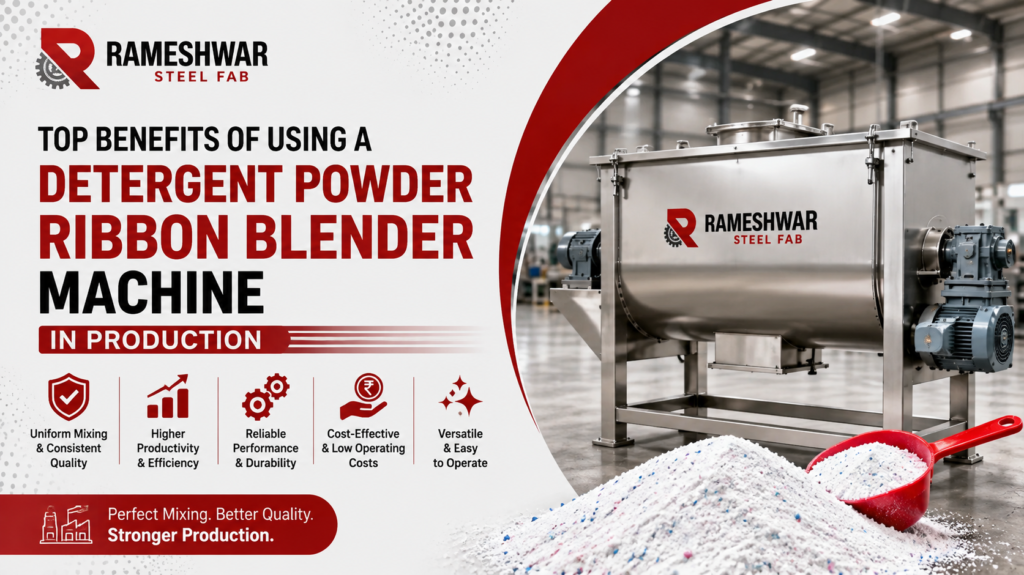
A ribbon blender is an industrial mixing machine commonly used for blending dry powders and granular materials. It consists of a horizontal mixing chamber equipped with specially designed ribbon-shaped blades.
During operation, the ribbons move the material in different directions, creating continuous movement throughout the mixing chamber. This helps distribute ingredients evenly and produces a more consistent detergent powder mixture.
The machine can be used for blending various detergent ingredients, including surfactants, builders, fillers, fragrances, and other dry components, depending on the formulation and production requirements.
1. Uniform Mixing of Detergent Ingredients
One of the most important benefits of a ribbon blender is its ability to achieve uniform mixing.
Detergent powder is typically made from several ingredients, and inconsistent distribution can affect the performance and quality of the final product. A ribbon blender continuously moves the material through the mixing chamber, helping distribute different components evenly.
This uniformity is particularly important when producing detergent powders where every batch needs to maintain consistent characteristics.
2. Improved Production Efficiency
Production efficiency is a major consideration for detergent manufacturers. Manual or inefficient mixing processes can require more time and labor while producing inconsistent results.
A detergent powder ribbon blender machine automates the mixing process and can handle substantial quantities of material in a single batch. This can help manufacturers reduce processing time and improve production throughput.
Faster and more consistent mixing allows production operations to run more efficiently, especially when large quantities of detergent powder are required.
3. Suitable for Large-Scale Production
Ribbon blenders are available in different capacities, making them suitable for a wide range of manufacturing requirements.
Manufacturers can select equipment according to their batch size, production volume, formulation, and available space. Larger-capacity machines can help support continuous or high-volume production operations.
This scalability makes ribbon blender technology useful for both growing detergent manufacturers and established production facilities.
4. Better Batch-to-Batch Consistency
Maintaining consistency from one production batch to another is essential for product quality.
Variations in ingredient distribution can lead to differences in detergent performance, appearance, fragrance, or other product characteristics. A properly operated ribbon blender helps create a repeatable mixing process.
By maintaining controlled mixing conditions and standardized operating procedures, manufacturers can improve batch consistency and reduce unwanted variations.
5. Effective Mixing of Different Powder Materials
Detergent formulations can contain materials with different particle sizes, densities, and physical properties. Efficiently combining these ingredients can be challenging with basic mixing methods.
The ribbon mechanism creates both horizontal and radial movement within the mixing chamber. This movement helps bring different powder components into contact with one another.
As a result, ribbon blenders can provide effective mixing for many dry detergent formulations when the machine is correctly selected and operated.
6. Reduced Manual Labor
Traditional manual mixing methods can require considerable human effort, particularly in large-scale production environments.
A detergent powder ribbon blender automates the core mixing operation. Operators primarily need to load ingredients, control the mixing cycle, monitor the process, and unload the finished material according to the plant’s operating procedures.
Reducing manual handling can improve workplace efficiency and allow workers to focus on other important production activities.
7. Easy Operation and Maintenance
Another advantage of ribbon blender machines is their relatively straightforward operating principle.
Depending on the machine design, operators can control factors such as mixing time, batch quantity, and operating speed. Proper access to the mixing chamber and suitable machine construction can also simplify routine cleaning and maintenance.
Regular inspection, cleaning, lubrication, and preventive maintenance can help keep the equipment operating reliably and extend its service life.
8. Flexible for Different Detergent Formulations
Manufacturers may produce different detergent formulations to meet specific market requirements. This creates a need for equipment that can accommodate different dry powder combinations.
A ribbon blender can be used for a variety of powder and granular formulations, provided the machine is appropriately designed for the materials being processed.
This flexibility can make the equipment useful for manufacturers producing multiple detergent products on the same production line.
9. Better Control Over the Mixing Process
Modern production environments require better control over manufacturing parameters. A ribbon blender allows manufacturers to establish standardized mixing cycles based on the characteristics of their formulation.
Factors such as mixing time, loading quantity, and operating speed can be optimized through production trials and quality testing.
Controlled mixing helps manufacturers develop a repeatable production process rather than relying heavily on manual judgment.
10. Helps Reduce Material Waste
Poor mixing practices can result in rejected batches, uneven formulations, or material losses. Improving mixing consistency can help reduce such problems.
A properly sized and operated ribbon blender promotes efficient contact between ingredients, which can contribute to better utilization of raw materials.
Manufacturers can further reduce waste by optimizing batch sizes, minimizing product residue, and following appropriate cleaning and material-handling procedures.
11. Supports Better Product Quality
Product quality is one of the most important factors in detergent manufacturing. Consumers expect detergent powder to provide consistent cleaning performance and product characteristics.
Uniform ingredient distribution contributes to overall formulation consistency. By using an appropriate mixing system, manufacturers can establish a more controlled process for producing detergent powder.
The ribbon blender therefore plays an important role in supporting consistent production quality when combined with proper formulation, processing, and quality-control practices.
12. Cost-Effective Production Solution
Investing in mixers that are functional can boost production for manufacturers and lessen the need for unnecessary manual operations.
A ribbon blender can combine several production advantages, including high batch capacity, automated mixing, reduced labor requirements, and repeatable processing.
Over time, these benefits can contribute to more efficient utilization of production resources. The actual cost-effectiveness depends on factors such as machine capacity, formulation, operating conditions, energy consumption, maintenance, and production volume.
Key Factors to Consider When Choosing a Detergent Powder Ribbon Blender
Selecting the right machine is important for achieving the expected production results. Manufacturers should consider:
- Batch capacity: Choose a machine that matches current and expected production requirements.
- Material characteristics: Consider powder density, particle size, moisture content, and flowability.
- Ribbon design: The configuration of the mixing blades should be suitable for the intended application.
- Construction material: Select appropriate materials based on the detergent formulation and cleaning requirements.
- Motor and drive system: Ensure the drive system can handle the required load efficiently.
- Cleaning requirements: Consider how easily the machine can be accessed and cleaned between batches.
- Safety features: Check for appropriate guards, emergency controls, and other safety provisions.
- Customization: Depending on the formulation, manufacturers may require options such as discharge arrangements, variable-speed drives, or specialized designs.
Conclusion
A detergent powder ribbon blender machine can provide significant advantages for manufacturers seeking consistent, efficient, and scalable powder mixing. From uniform ingredient distribution and improved batch consistency to reduced manual labor and better production efficiency, the machine can support several important stages of detergent manufacturing.
Selecting the proper ribbon blender is crucial. Capacity, material attributes, construction of the machine, mixing requirements, and maintenance requirements should all be considered prior to making a choice.
Looking for a reliable detergent powder ribbon blender machine for your production unit? Rameshwar Steel Fab offers robust and efficiently designed industrial mixing solutions to meet different manufacturing requirements. Get in touch with Rameshwar Steel Fab to discuss your application and find the right ribbon blender for your detergent powder production needs.