Dishwashing liquid isn’t going anywhere. Every household uses it,Every restaurant and hotel kitchen uses it in large quantities , and that steady demand is exactly why the equipment behind it matters so much. If you’re starting a small cleaning-product business or scaling up an existing manufacturing setup, the machine you choose to make your dishwashing liquid can make or break your production efficiency, your product’s consistency, and honestly, your day-to-day sanity on the factory floor.
Today’s dishwashing liquid making machines are built to take the mixing, blending, and processing work off your hands — or at least make it a lot less hands-on. And depending on how much you’re producing, you can find equipment that fits anywhere from a small batch operation to a large, continuous production line.
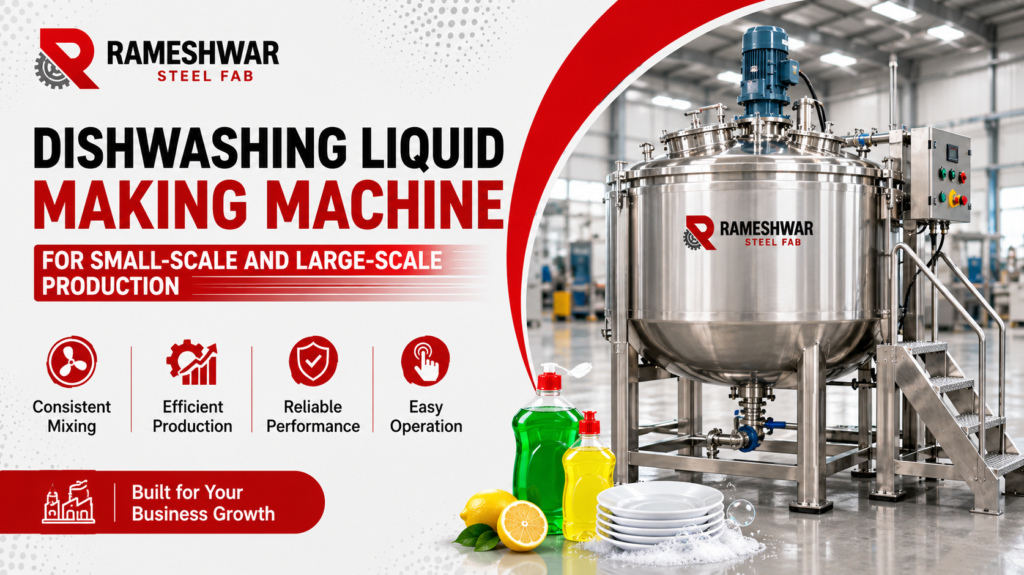
What Is a Dishwashing Liquid Making Machine?
At its core, it’s the piece of industrial equipment that combines and processes everything that goes into your formulation — surfactants, water, fragrances, colours, thickeners, preservatives, and whatever else your recipe calls for.
What you’re really paying for is uniformity. A good machine mixes everything evenly, batch after batch, so you’re not left guessing why one batch turned out thinner than the last. Features like high-speed mixing and controlled agitation are what make that consistency possible, and they’re a big part of what separates a decent machine from a great one.
How Does the Process Actually Work?
There’s no single “right” way to do this — it depends on your formulation, your capacity, and how your equipment is set up. But most production runs follow a similar general sequence:
Raw material addition — Water and the base ingredients go into the mixing vessel first, following your formulation.
Initial mixing — The agitator gets to work, building a uniform base to work from.
Ingredient addition — Surfactants, thickeners, fragrances, and colours get added in gradually, not all at once.
Homogenisation and blending — This is where continued agitation makes sure every part of the batch has the same composition, not just the top layer.
Consistency check — Before anything moves on, someone checks the viscosity, appearance, and overall uniformity of the batch.
Transfer and filling — Once it passes muster, the liquid heads to storage or straight into a filling line for packaging.
Again, your exact process will look a little different depending on your formula and setup — this is just the general shape it tends to take.
If You’re Producing on a Smaller Scale
Not every business needs a massive production line, and there’s no reason to buy one if you don’t. A compact dishwashing liquid making machine can get you consistent, reliable batches without the overhead of equipment you don’t actually need yet.
This kind of setup tends to work well for:
- New cleaning-product businesses just getting off the ground
- Local or regional manufacturers
- Trial runs and formulation development
- Private-label production
- Small and medium production units
When you’re choosing equipment at this scale, think beyond just today’s needs. Batch capacity, floor space, power requirements, and how easy the machine is to operate all matter — but so does whether it can grow with you a little before you need to replace it entirely.
If You’re Running a Large-Scale Operation
Bigger facilities need machines that can keep up — higher batch volumes, frequent cycles, and the ability to plug into a larger production line without becoming the bottleneck.
At this scale, a few things become non-negotiable:
- Higher batch capacity
- Mixing performance that doesn’t drop off as volume increases
- Solid, durable construction that can handle daily use
- Consistent quality from the first batch of the day to the last
- Smooth material transfer between stages
- A design that’s actually easy to clean and maintain
- Compatibility with your storage and filling systems
- The ability to integrate with the rest of your production line
Get this right, and you cut down on manual handling and keep the whole operation running smoother.
What to Actually Look For Before You Buy
It’s easy to get caught up in specs, but the machine needs to match your formulation and your production goals — not just look impressive on paper.
Mixing efficiency. The agitator and mixing setup need to suit the viscosity and character of your specific formulation. What works for a thin liquid won’t necessarily work for a thicker one.
The right batch size. Bigger isn’t automatically better. Oversized equipment ties up capital you might not need to spend, while undersized equipment will cap your growth sooner than you’d like.
Build material. Stainless steel is the go-to for a reason — it holds up well, stays hygienic, and cleans easily, which matters a lot for anything that touches your product.
Ease of operation. If your operators are fighting the controls, something’s wrong. The machine should make the process easier, not add another layer of complexity.
Cleaning and maintenance. Cleaning is part of the job in liquid detergent production, not an afterthought. A vessel that’s a pain to access will slow you down every single time.
Why Bother With Dedicated Equipment at All?
More consistent mixing. Mechanical mixing simply distributes ingredients more evenly than doing it by hand ever could — and that consistency is what customers (and your quality control team) notice.
Less manual labour. Automating or semi-automating the mixing process takes a real physical load off your operators.
Better efficiency. A dedicated machine streamlines the whole process, so you’re not reinventing the wheel with every batch.
Room to grow. You can start with what fits your current needs and add to your setup as demand increases — no need to overbuild from day one.
Tighter process control. Controlled mixing parameters mean you actually stick to your formulation, batch after batch, instead of drifting over time.
How to Actually Choose the Right Machine
A few questions worth sitting with before you commit to a purchase:
- How much are you actually producing? Get realistic about your batch size and daily output — current and projected.
- What does your formulation demand? Viscosity and ingredient mix will shape what kind of mixing setup you need.
- What materials make sense for your product? Your formulation should guide what the product-contact surfaces are made of.
- Do you have the space? Check dimensions and installation requirements before anything else.
- What are your power requirements? Motor capacity and electrical load matter more than people expect.
- Where do you see this going? If growth is on the horizon, it’s worth choosing a configuration that can handle it.
- How much maintenance are you signing up for? Practical, accessible designs save you time down the line.
It Really Comes Down to the Equipment
The quality of your finished dishwashing liquid depends on a lot of things — your formulation, your raw materials, how you process everything, your general production practices. But the machine doing the mixing is the constant thread running through all of it, batch after batch.
The goal isn’t to buy the biggest, most powerful machine you can find. It’s to buy the one that actually fits what you’re making and how much of it you need to make.
Looking for a Reliable Dishwashing Liquid Making Machine?
That’s where Rameshwar Steel Fab comes in. We manufacture and supply industrial mixing and processing equipment built for small-scale, medium-scale, and large-scale production — whatever stage your business is at.
If you are planning to start or expand dishwashing liquid production, selecting the right mixing equipment is an important step toward building an efficient manufacturing operation. Contact Rameshwar Steel Fab today to discuss your requirements and get a suitable Dishwashing Liquid Making Machine for your business.